Technology
How AI will replace programmers (and why that's brilliant)
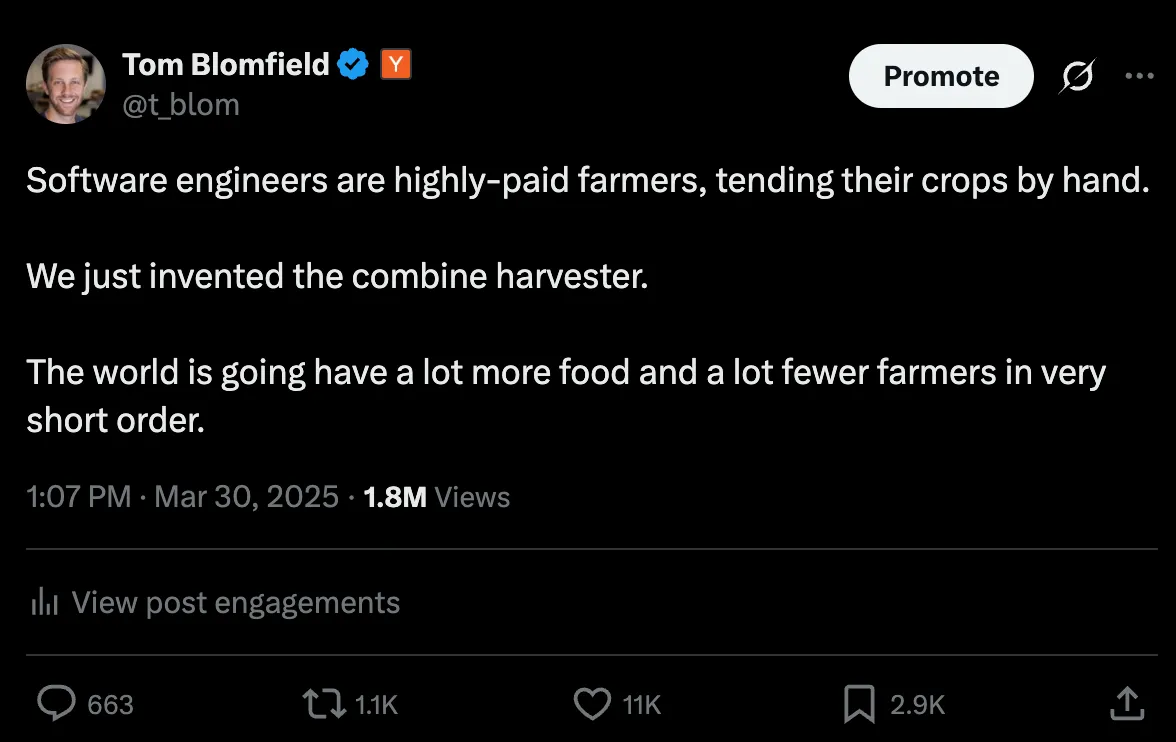
A recent conversation between Y Combinator partners Tom Blomfield and David Lieb over a post made by the former on X.com. Tom's analogy comparing software engineers to "highly paid organic farmers" awaiting their "combine harvester moment" has touched a nerve—and revealed a truth many aren't ready to face.
But the data tells a story that's impossible to ignore.
🧠 The combine harvester moment for code
Tom's farming analogy cuts deep because it's historically accurate. The combine harvester didn't just make farming more efficient—it eliminated 90% of farming jobs whilst increasing food production by orders of magnitude.
"The first computer programmers that existed didn't do a job that was anywhere like today's software engineers," Tom noted. "They were writing machine code. They were making punch cards."
The progression is clear: each generation of programming tools has abstracted away the previous layer of complexity. Now, AI coding agents represent the next—and perhaps most dramatic—abstraction yet.
The Y Combinator data reveals everything
The numbers from Y Combinator cohorts tell the story of transformation in real-time:
→ Two cohorts ago: Approximately 0% of founders used AI as their primary coding method
→ Last cohort: 25% of companies used AI tools for most of their code
→ Current cohort: 33-50% primarily write code using AI agents
This isn't gradual adoption—it's exponential transformation happening at the cutting edge of entrepreneurship.
💡 What Tom's experiment revealed
Tom Blomfield, co-founder of Monzo Bank, decided to test these tools himself. What he discovered shocked even him.
Starting with simple games built using no-code tools like Lovable and Replit, he quickly moved to more sophisticated platforms like Cursor, Windsurf, and Claude Code. His breakthrough project: rebuilding his 20-year-old Tumblr blog.
"In 90 minutes, I set up hosting, I wrote new blogging software, and I migrated 15 years of blog posts over to the new platform," Tom revealed.
But the real test came with recipes.ai—a serious application with 35,000 lines of code, thousands of users, and a full interactive voice agent.
The kicker? Tom wrote zero lines of those 35,000.
"After about the first 5,000 lines, I stopped even reading the code," he admitted. "I just prompt, I'd auto accept, I'd go and make a coffee and I'd come back and a new feature was built."
This from someone who hadn't written code professionally for 10 years—yet found himself more productive than when he was actively coding a decade ago.
📊 The Jevons Paradox argument (and why it misses the point)
Critics quickly deployed the Jevons Paradox defence: as the cost of software development plummets, demand will increase exponentially, maintaining or increasing employment for programmers.
Subscribe to the Newsletter
Join thousands of ambitious creators receiving exclusive strategies, tools, and inspiration to grow and monetize their brands.